Iron Maiden’s Somewhere in Time artwork shows an armed cyborg in a neon-lit city, with bars, restaurants, a cinema and the pyramids in the distance. It makes a pretty good T-shirt.
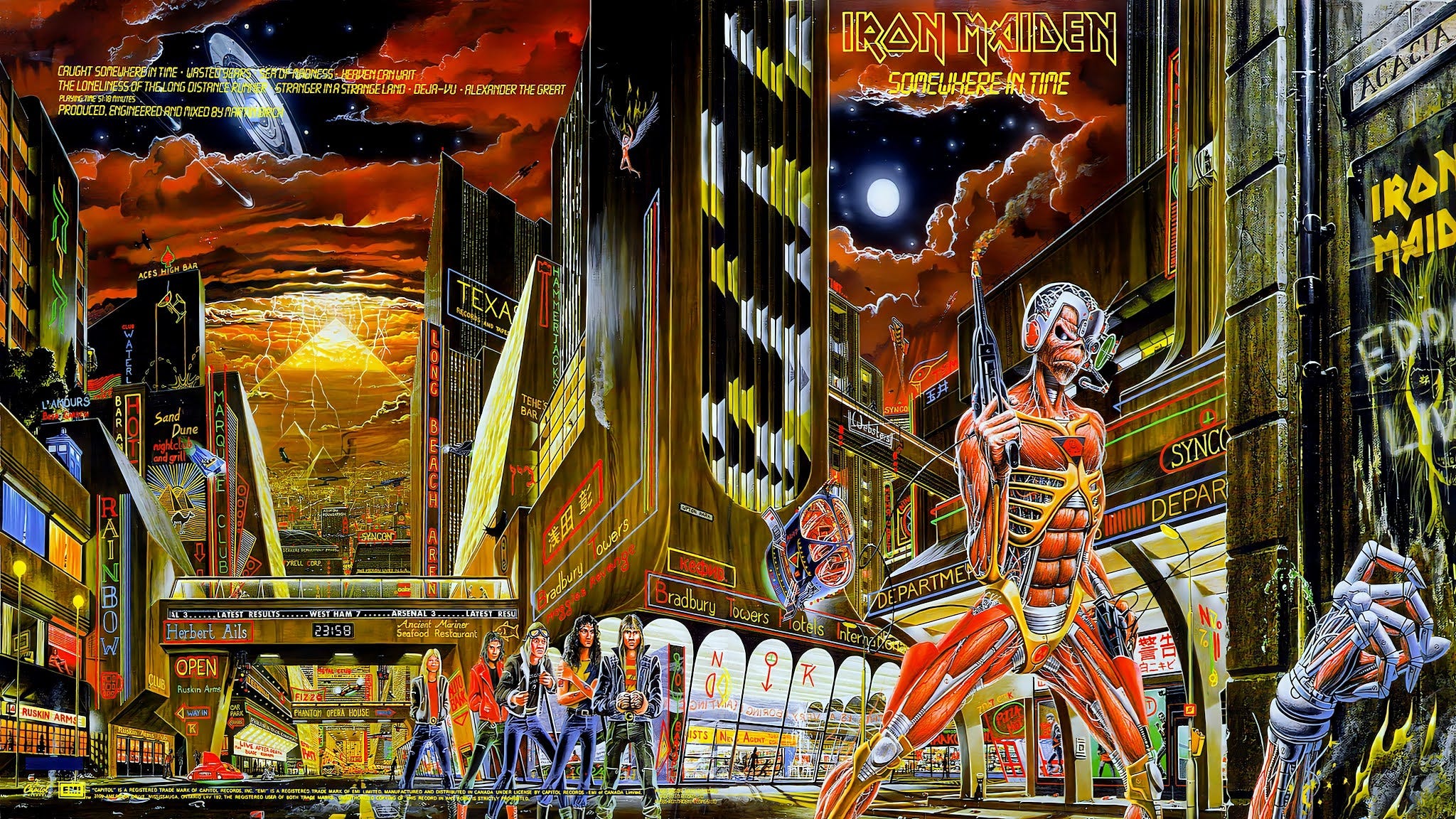
But if you squint and read the signs, there’s a reason for the time on the clock, the name above the pub, even the football score.
The clock reads 23:58. Two minutes to midnight, like their song. The pub is the Ruskin Arms, where they played in their early days. Elsewhere, a sign says “Websters,” a shout-out to Charlie Webster, EMI’s art director. On a scoreboard, West Ham have conveniently managed to thump Arsenal 7-3. Iron Maiden’s bassist, Steve Harris, is a West Ham fan.
In Gordian’s early days, there were six of us, about a rock band’s worth of people. We liked the idea of a band T-shirt we might wear for years, designed and made with the same care we brought to our science. Several of us are doodlers, so we began sketching, tucking inside jokes and references to our experiments into our drawings, some so small and subtle you’d have to look closely to find them.
As Gordian grew, we kept making shirts, each stuffed with references to new people and experiments. Together, the three designs we created form a history of Gordian, tracing our growth from that first small team to the company we are today.
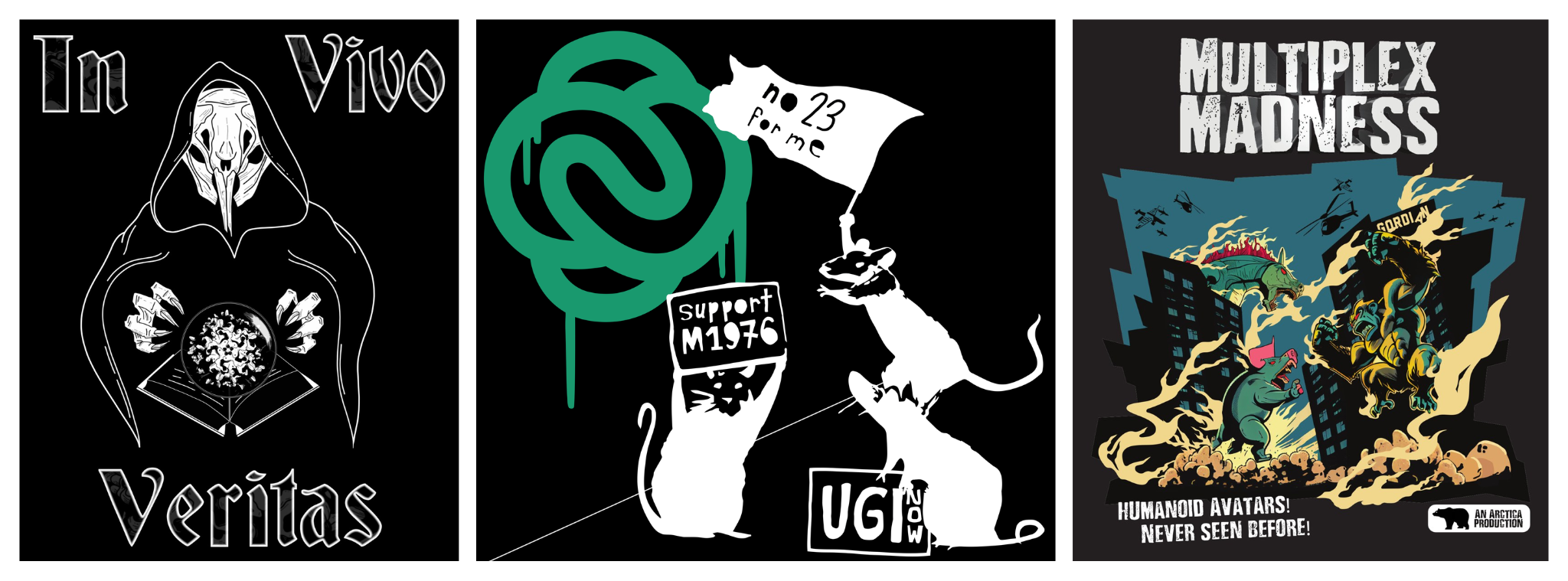
In Vivo Veritas
September 2019
Our first shirt started with Gordian’s motto: “In vivo veritas,” truth in the living organism. It’s a play on in vino veritas, truth in wine, and describes how we work: study disease directly in living organisms.
With the rock-band look in mind, we went from Latin to the occult. Chris Carrico, one of our first four employees, sketched a live mouse in a wizard’s robe, gesturing over a crystal ball on a book. Martin drew the back on a napkin: an eye and triangle at the top, wings, a knot in the middle and a ring of symbols. We were already looking for places to put the science: “Some transcriptomic data in eye/iris?”, “UMAP occult symbols” and “Knot ≈ AAV?”.
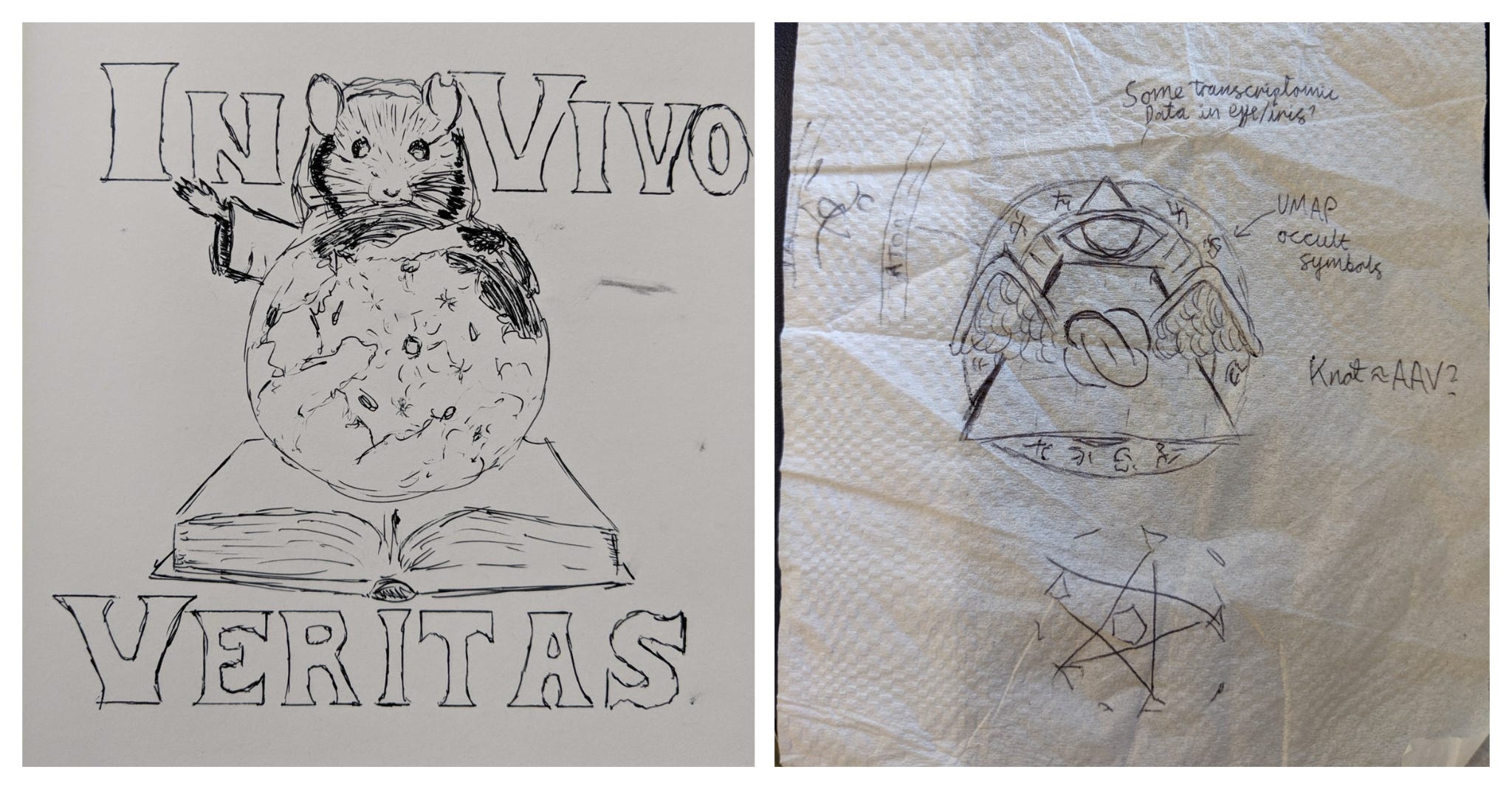
We brought the sketches to designer and graffiti artist JJ Moi. We cared a lot about the craftsmanship and went back and forth with him through several drafts.
The mouse was still a little too cute for the goth-metal look we wanted. Soon enough, the live mouse became more dead and the paws became claws. We kept adjusting the figure to make it easier to recognize, enlarging the skull and bringing back the robe as a simple outline. We saved the detailed linework for the wings on the back.
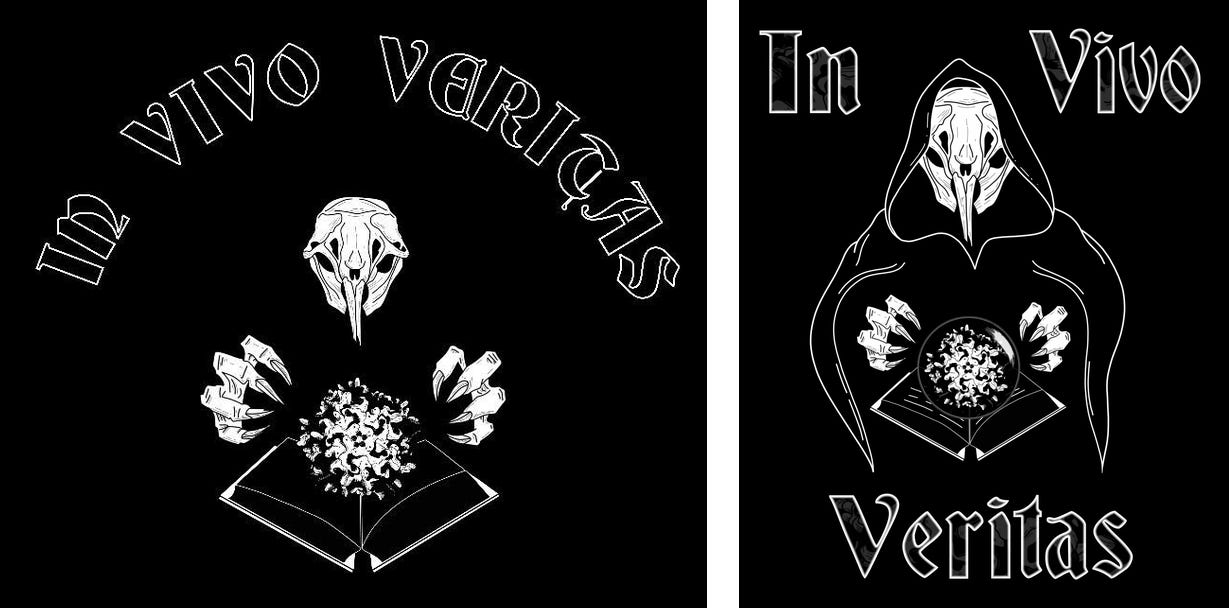
Martin’s layout barely changed, but we wanted less solid white on the back to match the front. We tried wings filled with white and wings drawn in white on black, and played around with how to stack the triangles. The dark wings stayed, and the pentagram at the bottom of the napkin didn’t make it.
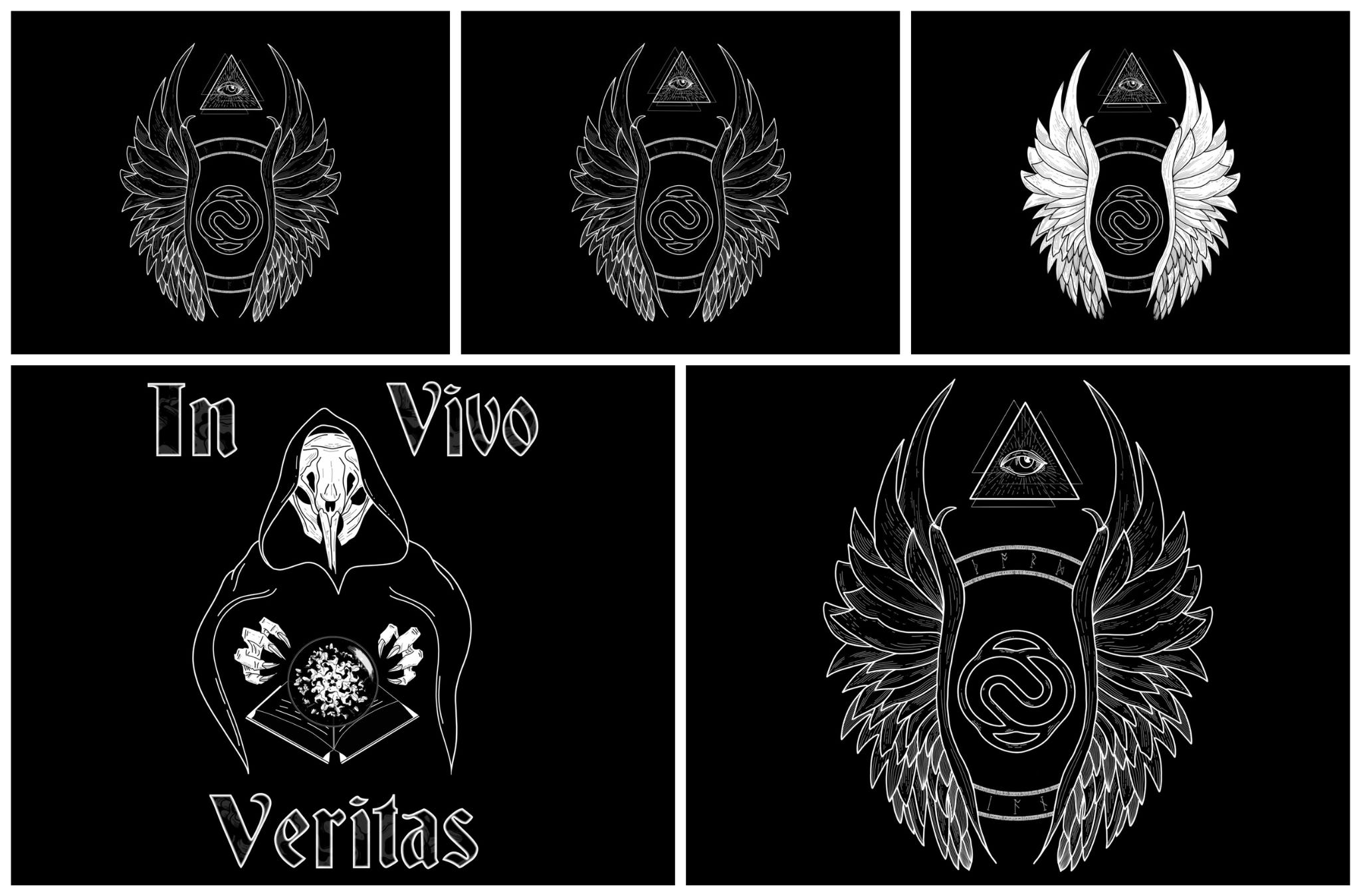
We had our first shirt, with bits of our science worked into the occult imagery.
Our oracle is a dead mouse because we run most of our experiments in mice. The hood was just to make the skull a little creepier. For the crystal ball, we used the protein structure of an adeno-associated virus (AAV) capsid. We use AAV to deliver our screens, so here it reveals the veritas.
Above it, The eye and pyramid above are similar to the Illuminati on the US dollar, with triangles inspired by the valknut behind them. The valknut fits the occult theme and is also a knot. There’s no hidden meaning in the wings. We just thought they looked cool.
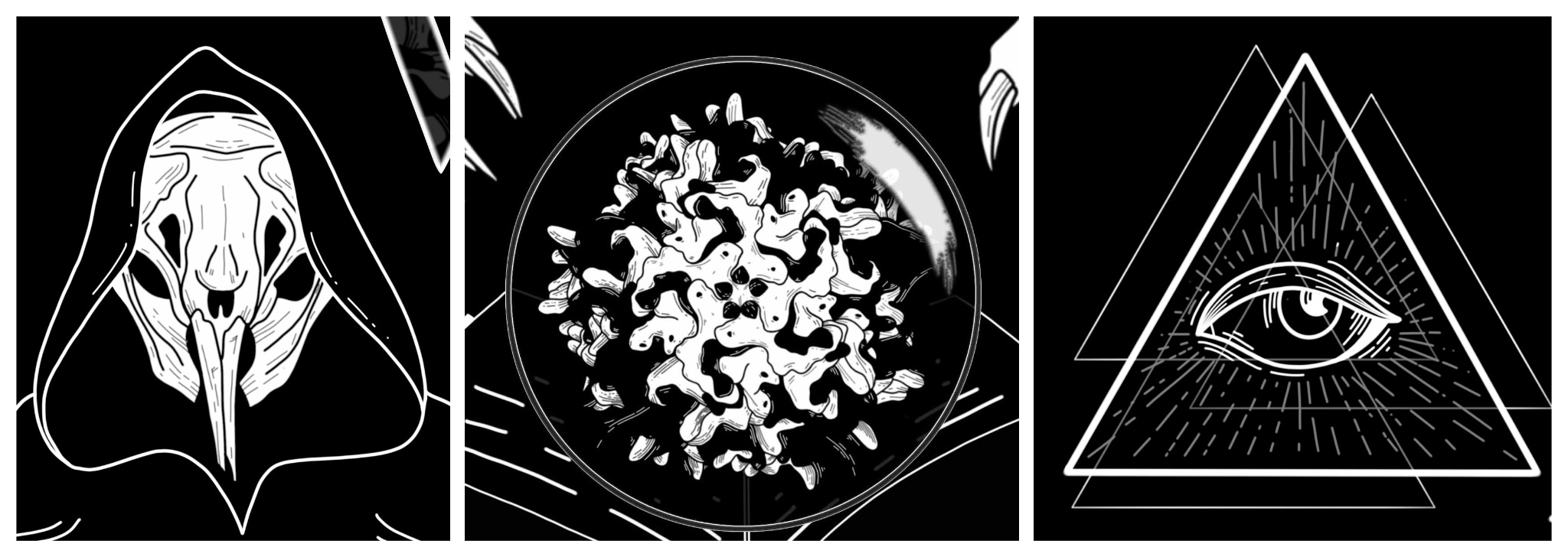
Between the DNA bands are what look like runic letters. Up close, each is a cloud of dots, like cells on a UMAP plot. These plots show single-cell gene expression data. JJ used that look to spell GORDIAN in a loose version of the Norse futhark alphabet.
As for our own names, we were a bit more creative. We hid them in the bands around the runes. From afar, they look like lines, but if you get really close, you can make out letters spelling out DNA. Translate the sequence into protein and read the one-letter amino acid code to find the team: co-founders Martin Borch Jensen and Francisco LePort, and our first four employees, Daniel Fuentes, Chris Carrico, Chris Towne and Ian Driver.
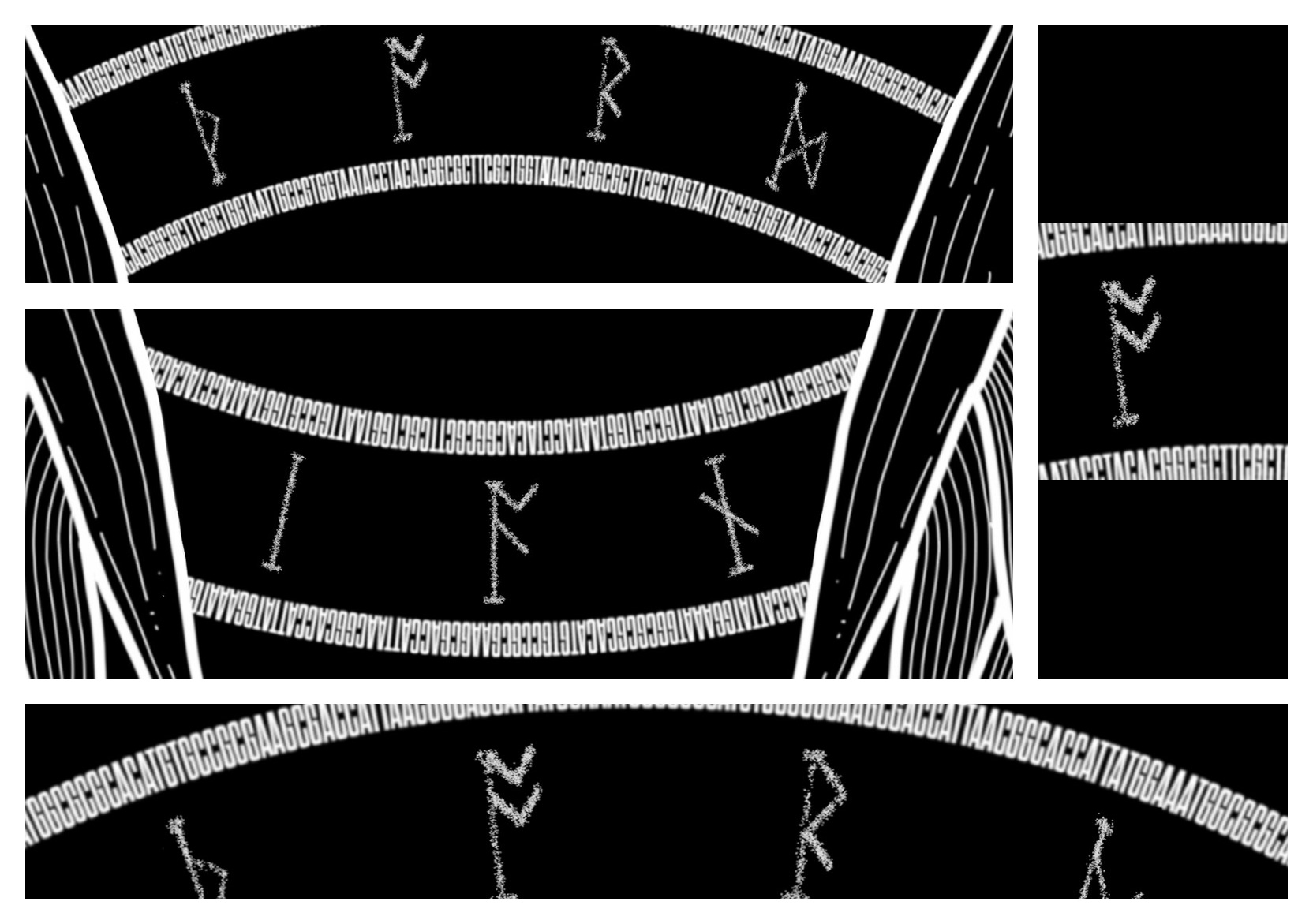
We asked how many letters would fit, then sent JJ two complementary DNA sequences for the rings. We even asked him to line up matching bases across them: A opposite T, G opposite C. Francisco’s name gave us trouble because there’s no standard amino acid for O, so we ended up using a stop codon.
The Revolution
July 2021
By our second shirt, there were eight of us at Gordian, and we’d got our barcoding technology to work… after some mishaps.
The design started with two numbers from one set of experiments: 1976 and 23. Barcode #23 had behaved unusually in mouse #1976, and the data from that mouse had helped us get our barcoding technology working.
1976 is one digit away from 1776, which got us thinking about the American Revolution. The project that followed up on barcode #23 was called EqualityForAll, which suggested the French Revolution too. We worked with JJ again. He turned that idea into Banksy-style urban rebels: stenciled mice with protest signs and paint dripping down the design.
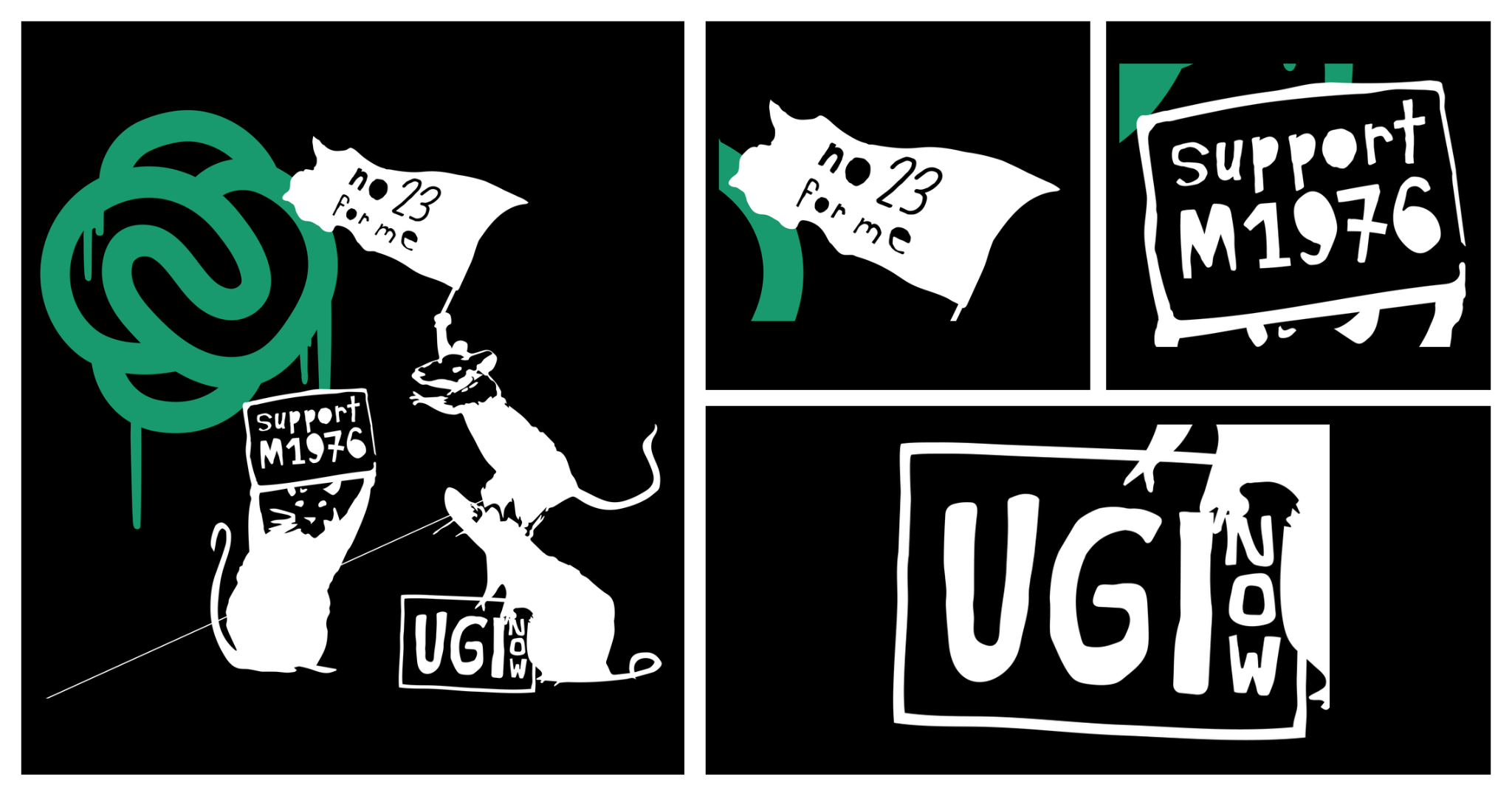
We’d loved how much there was to discover on our first shirt and asked JJ for a fuller scene: eight mice, one for each of us, with more banners and lab details like pipettes and goggles.
We made a few recommendations to JJ: with more mice on screen, we’d need shorter slogans, bigger banners and clearer letters. We also reconsidered where the logo should go. We first planned to put the logo on a banner, then considered spray-painting it on the ground or a wall behind the mice. That would make it part of the scene without adding tiny details. On the finished shirt, the Gordian knot looks like green spray paint, dripping and partly hidden by a sign. We printed the rest in white on a black shirt.
Mouse #1976 got its own protest sign, “Support M1976.” For barcode #23, we scrawled “no 23 for me” beside the logo, a play on 23andMe. Our barcoding technology gave us another slogan: UGI, short for universal genome identifier, is one letter away from UBI, universal basic income. We put “UGI now” on a placard below the knot.
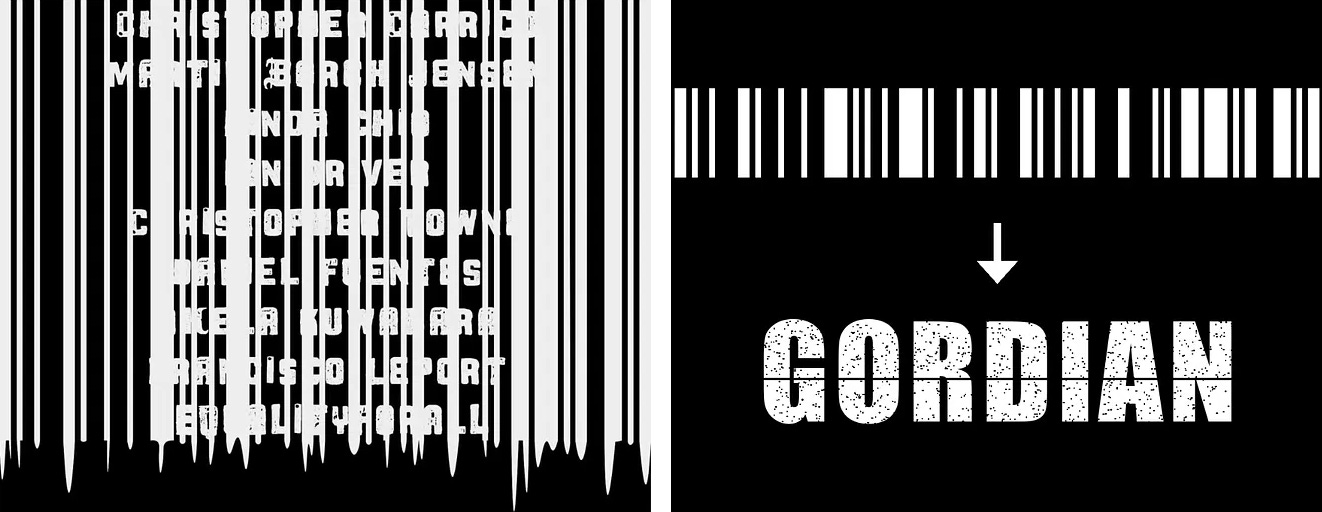
The barcoding work gave us the design for the back too: a real barcode that encodes “Gordian.” Its bars melt at the bottom, like the spray paint on the front. This time, we printed our names in distressed type behind the barcode. All eight of us were there: Christopher Carrico, Martin Borch Jensen, Linda Chio, Ian Driver, Christopher Towne, Daniel Fuentes, Akela Kuwahara and Francisco LePort. Below our names, we added “EQUALITYFORALL,” the project name that had inspired the theme.
We liked the shirt as much for its rebel mice and dripping paint as for the stories we’d worked into it. We wanted every shirt after to be just as great.
Multiplex Madness
November 2023
After our 2021 Series A, we were scaling up our screens and had moved into large animals. With a bigger team and a building of our own, it was time for a third shirt.
The mice on our last shirt had staged a revolution. Now we were screening in pigs, horses and primates, and we made them big enough to tear a city apart. We borrowed the idea from Rampage, the arcade game where giant monsters climb buildings and smash them. We let JJ play with the anatomy as long as the animals were recognizable.
This time, we wanted a colorful design that would last for years on fabric. On an earlier shirt, some of the colors faded quicker than others. We decided to use a smaller set of colors, and made a more intricate version for posters.
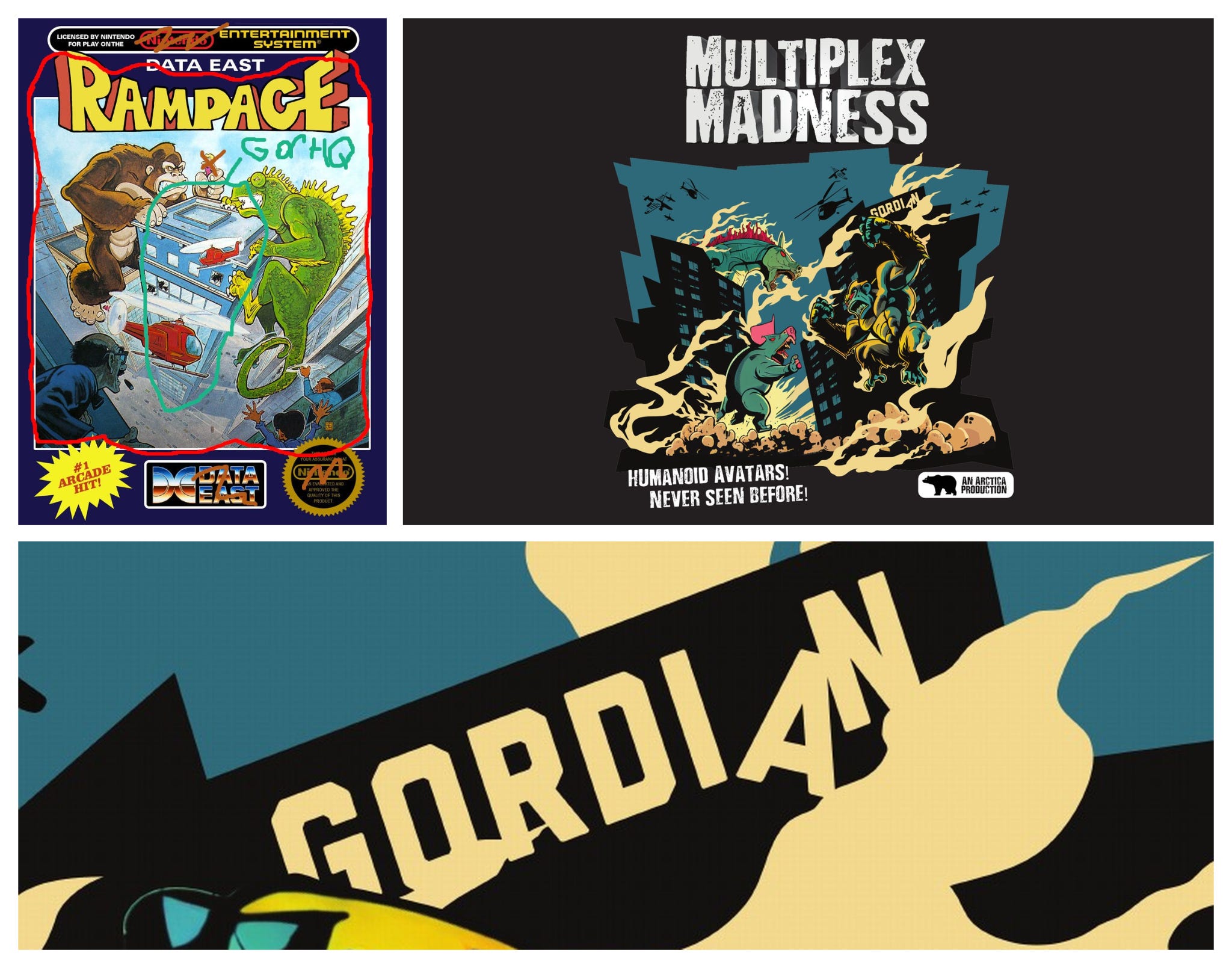
We marked the middle building on the NES Rampage box “Gor HQ” and let JJ decide where to put it. It ended up in the background, behind the primate’s raised hand. We’d changed our logo by then (“cut not knot”), so the building got a GORDIAN sign instead of the old knot.
Once the illustration was finished, we added the title and surrounding text. Our pooled screens gave us “Multiplex Madness”: we test many perturbations in the same animal at once. We already called our models “patient avatars,” so “Humanoid avatars!” went on the box. “Never seen before!” was a game-box boast we’d earned: we were running the first screens of this kind in large animals with disease, testing hundreds of potential treatments and measuring their effects cell by cell.
Arctica had helped bankroll the work by leading our Series A, so their bear logo went on the front with “An Arctica production.” We billed it as the “Sequel to the smash 2018 hit”: our seed round was in 2018, and the Series A was the sequel.
There were about 30 of us by then, a lot of names to hide in code. We collected titles for a credits screen on the back. Under “Bigger, Faster, Stronger!” our CEO, Francisco, became the “Executive producer” for leading fundraising and the team’s work. Martin, our CSO and co-founder, got “Story” for setting the scientific direction.
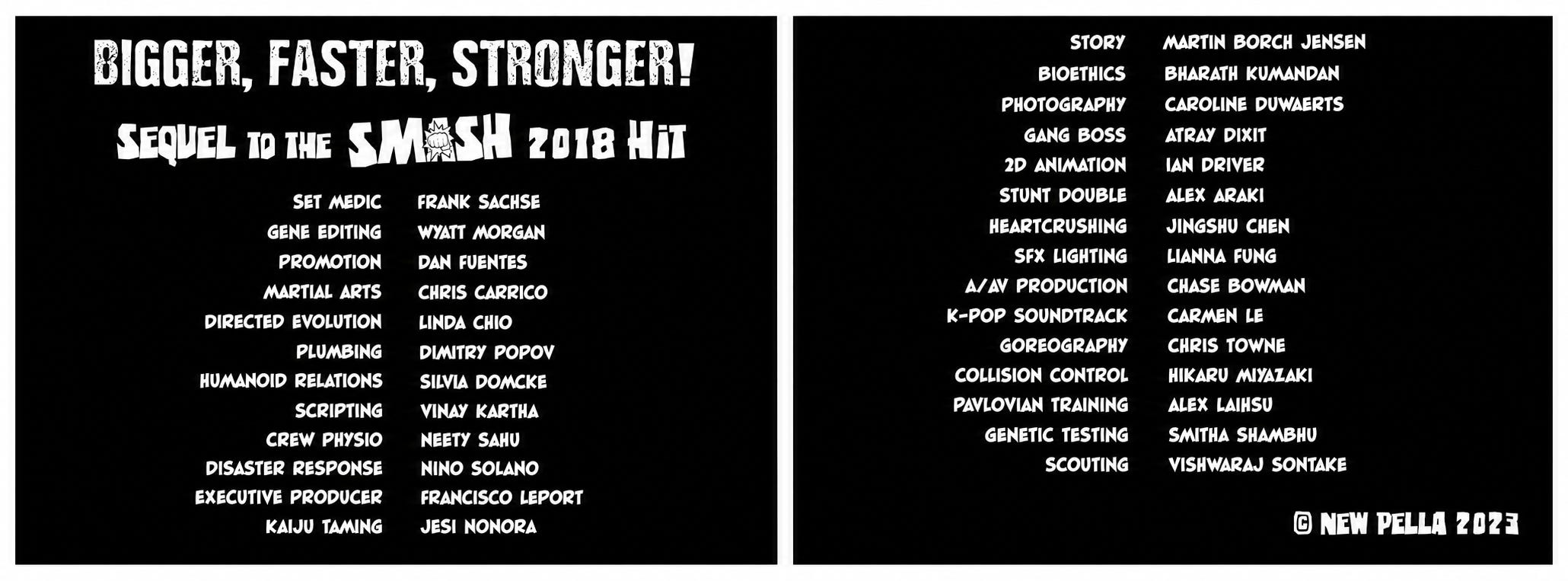
Jesi, who looked after our mice and rats, got “Kaiju taming.” Our osteoarthritis researcher, Neety, became the “Crew physio.” Chase produced viral vectors, so he got “A/AV production,” combining audiovisual production with AAV. The production roles were starting to sound quite a lot like the lab.
Dan designed and cloned our screening libraries, so his “Promotion” credit nodded to DNA promoters. “Directed evolution” went to Linda, who had used the protein-engineering method to make enzyme libraries in Frances Arnold’s lab. Chris Carrico’s “Martial arts” came from years of practicing Escrima. We couldn’t resist giving Chris Towne “Goreography.”
Vinay, our computational biologist, got “Scripting,” while Dimitry’s data pipelines and databases became “Plumbing.” Nino looked after lab and building operations, which earned him “Disaster response.”
For the copyright line, we used our office’s nickname: New Pella. Pella was the capital of ancient Macedonia, whose king Alexander the Great cut the Gordian knot. We added the year to sign off the production: “© New Pella 2023.”
We’re quite pleased with our Limited Edition shirts, and already designing the next one to celebrate 2022-2026 milestones (including surviving and flourishing through the biotech Fimbulwinter).
How do you get one of these shirts, you ask? Well, the only way is to join the team.