From our founding, Gordian was designed as a machine that systematically reveals the right way to cure diseases. The machine has now been built and is working through one disease after another, to create time for lives to bloom.
There are still many diseases left to cure. New hypotheses arise from genomic and proteomic data, in silico predictions, and more. But in conventional drug discovery programs, causal validation approaches can test only a few targets per year. For lack of a better alternative, drug development programs are launched based on this limited insight. Being forced to make bets before all the cards are flipped is inherently risky, and with the time it takes to confirm the bets you normally only get to play a few rounds in your career. So it’s natural to minimize risk by prioritizing targets with more supporting evidence and precedent.
This pull is evident in the industry’s pipelines. The number of clinical programs with novel targets dropped from ~100/year a decade ago to ~30/year in 2024. The result is tremendous target crowding. Just 37 targets, approximately 2% of all targets in active R&D, account for ~25% of the pre-clinical and clinical R&D pipeline. Increasingly, the industry is competing to extract value from this narrow set of options.
We get better and better at making a drug once we know what to do, but we’re still placing our bets based on what we know after turning over just a couple of cards. Is there a way to see the whole deck before we have to place our bets?
We developed Mosaic Screening to flip this process. This approach uniquely lets us see the causal effects of hundreds of barcoded perturbations directly in vivo, and resolve their individual effects on pathophysiology at scale. Rather than choosing a few plausible targets up front, Mosaic Screening gives us causal evidence for every target up front, to then choose the best ones to turn into drugs.
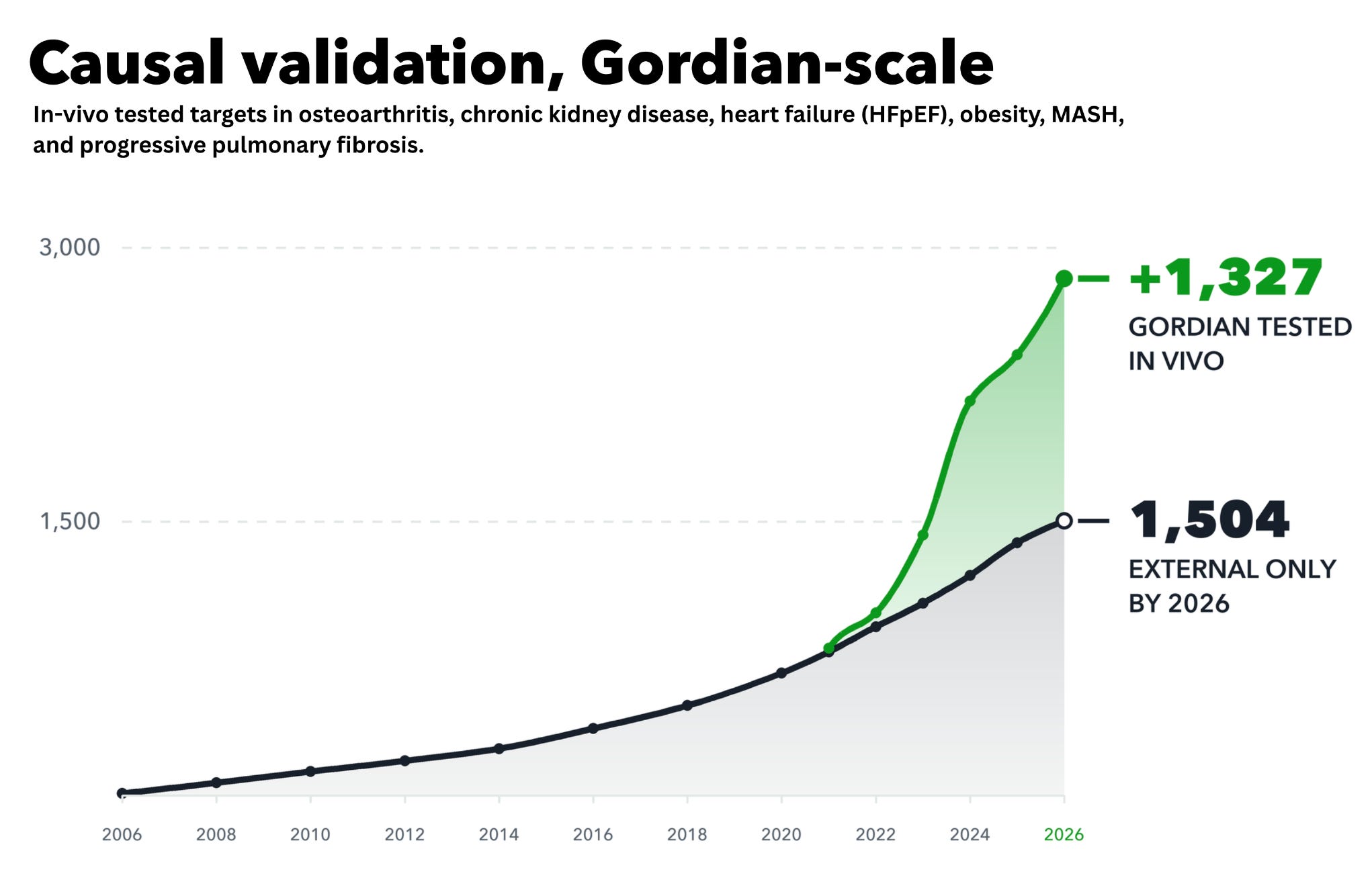
Across our six disease areas, we’ve mapped the in vivo effects of nearly as many targets as the global biomedical research community reported in the last twenty years.
We’re on track to triple the number of targets with in vivo causal validation data by the end of next year.
We’ll be reporting on our progress along the way. To catch you up on the past year and a bit, we have most notably:
Found a novel drug candidate, which is now on its way to the clinic. Omen 13 emerged from our osteoarthritis screen and is now in IND-enabling studies, following an INTERACT meeting with the FDA.
Expanded to six disease areas with a focus on cardio-renal-metabolic disease, testing >600 additional target-disease combinations across heart failure (HFpEF), obesity, and our new chronic kidney disease program.
Announced a research collaboration with Pfizer applying Mosaic Screening to in vivo target discovery for obesity.
Expanded the biology we can work on, adding new disease models, physiological readouts of heart, lung, and kidney function, and additional ways to assess toxicity.
Mapping the causal effects of hundreds of perturbations in living tissue
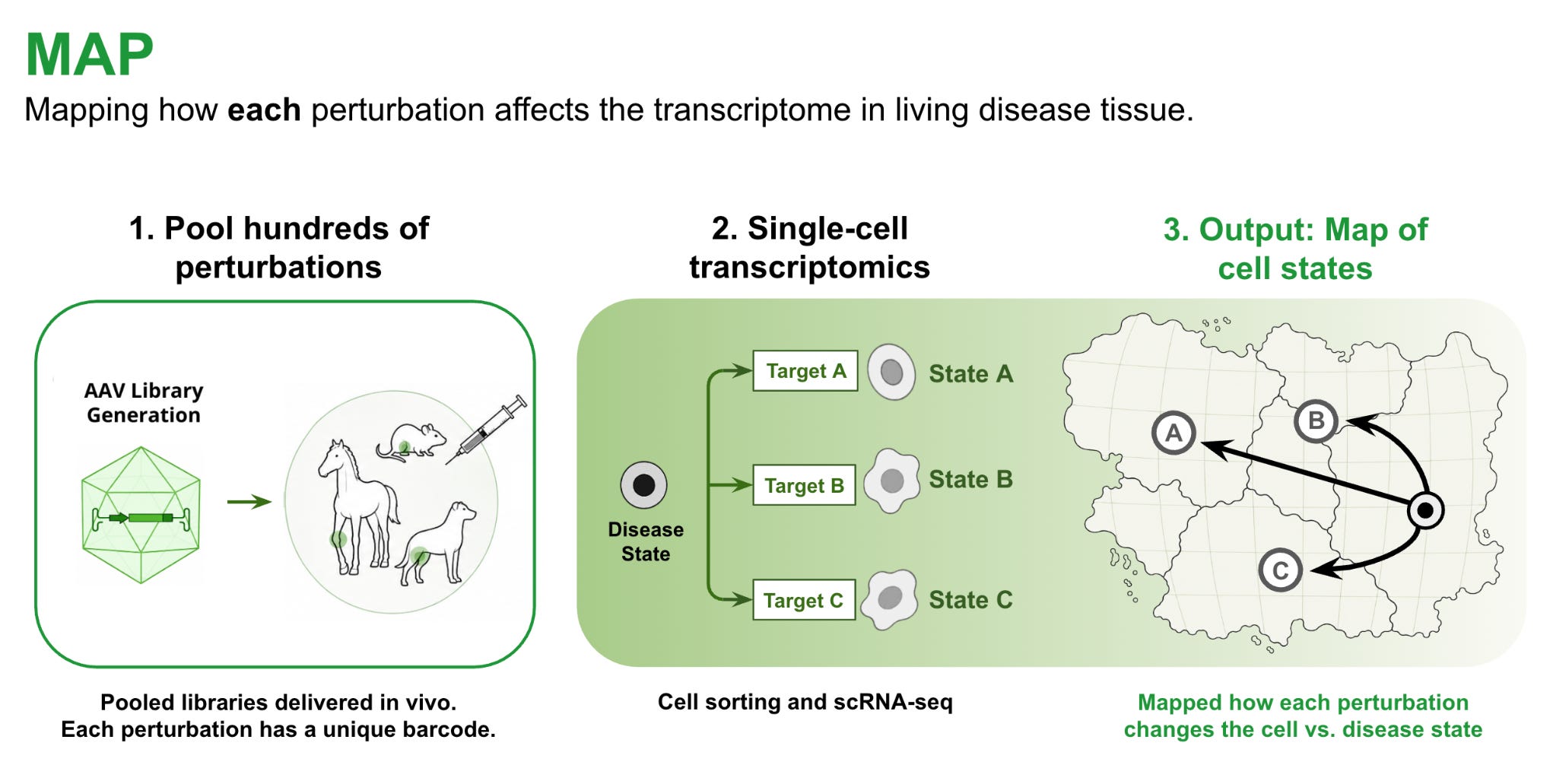
Imagine you could test hundreds of targets in vivo. How do you find out how each one affects disease in living tissue?
In Mosaic Screening, perturbations are delivered together, each at a sub-saturating dose, creating mosaic tissue in which cells carrying different perturbations sit adjacent to one another. The output is a causal map showing how each perturbation changes the state of cells, across hundreds of targets tested inside the same living diseased tissue.
We are currently mapping cardiorenal and metabolic diseases, where rising diagnosis rates have sparked renewed interest but validated targets are scarce. Biopharma faces a familiar problem in scaling up validation, because these diseases don’t manifest in vitro. Cultured heart cells don’t beat, cultured fat cells don’t mature, and the whole ‘metabolism’ part is missing from isolated cells.
So the first wave of new therapies have focused on known targets and repurposing. Beyond the resounding success of GLP1s, attempts to repurpose treatments from e.g. other types of heart failure to HFpEF have been disappointing. Mosaic screening will deliver the next wave of novel targets, validated in living systems suffering from cardiometaborenal syndrome.
Over the past year we’ve expanded our mapping to cover the main four tissues involved in cardiorenal/metabolic disease. With new models and delivery tools, we can now do mosaic screening in a growing range of disease contexts, including uninephrectomy, 5/6 nephrectomy, as well as CKD 2D and PCKS models.
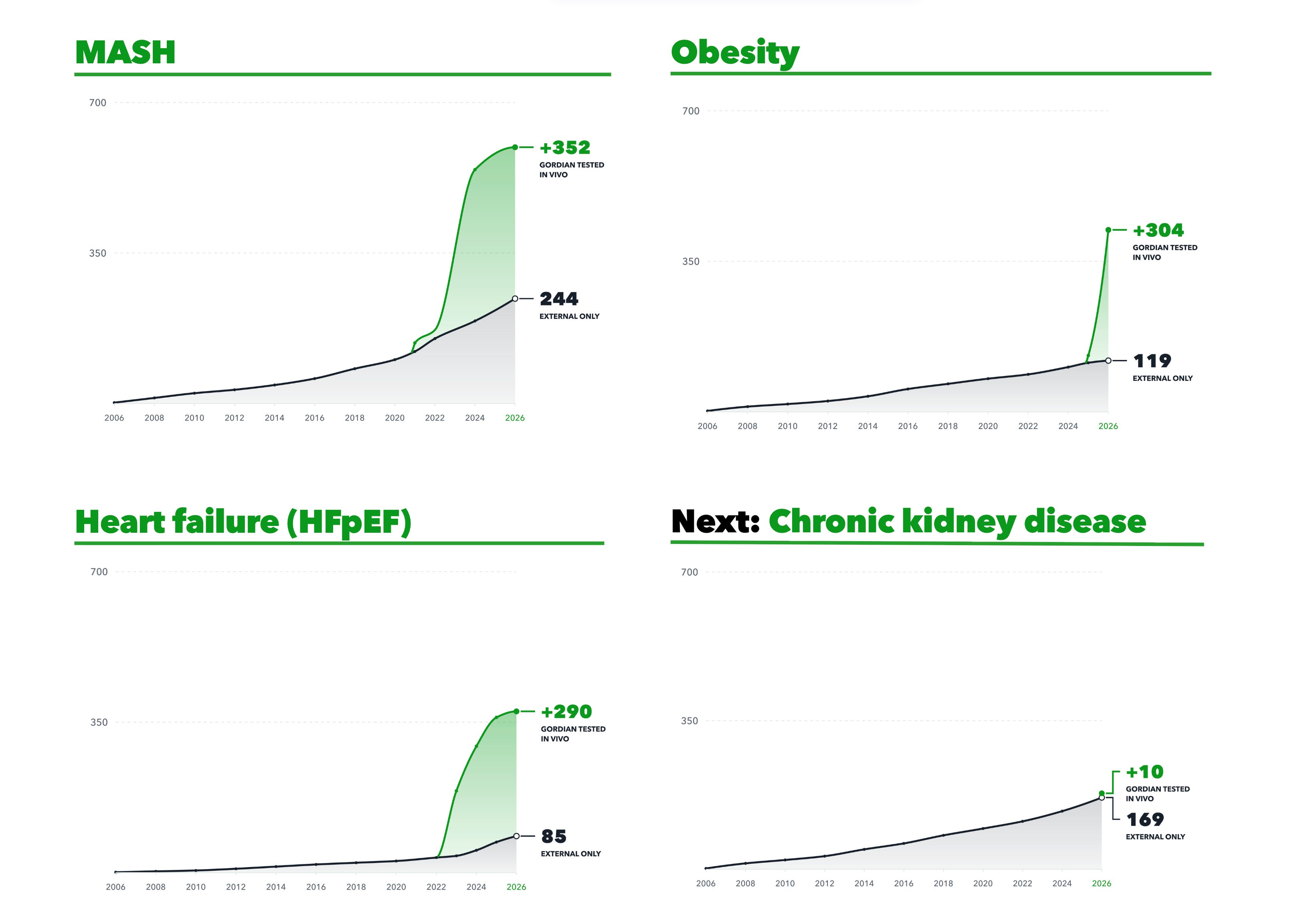
In our cardio-renal-metabolic program we have so far tested 352 targets in MASH, 304 in obesity, and 290 in heart failure. In each case, over double the number the field has reported in two decades. The machine now continues in chronic kidney disease.
But knowing where a perturbation takes a cell is not yet the same as knowing whether we want to go there. Causal maps show us where each target perturbation takes the transcriptome, but how do we know whether that destination is therapeutic?
Keys to which areas of the causal map correspond to therapeutic maxima
Maps show the terrain, but leave the destination up to you. To tell us which direction leads to cures, these causal maps need a key that bridges the gap between transcriptomic effects and physiology.
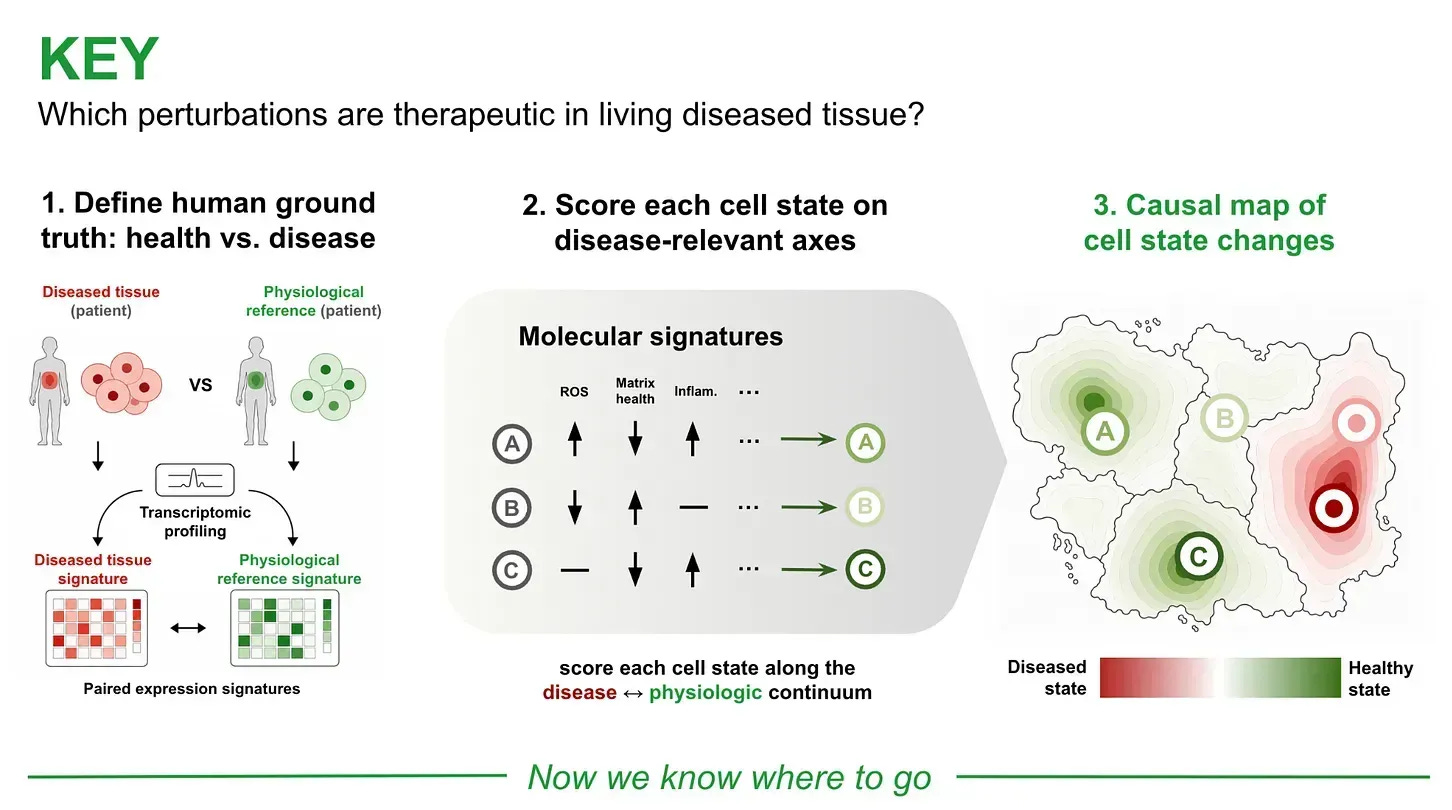
Over the past year, our keys have become substantially richer. Measuring lung function by FlexiVent, kidney function by transdermal GFR, or diastolic heart function using Pressure-Volume loop tells us directly whether disease is getting better or worse. We added more physiological readouts that directly measure disease , and produced paired datasets that span transcriptomics and physiology. We’ve also expanded our ability to assess whether perturbations are toxic using a validated 2D hiPSC-CM system to measure effects on sarcomere structure, inflammation, fibrosis, and cell death.
Together, the map and the key reveal the optimum within each disease’s screened target space. The map tells us what each perturbation does, and the key tells us which of those effects are therapeutic. That lets us select the best targets and build drug development programs around them.
Turning maps and keys into medicines
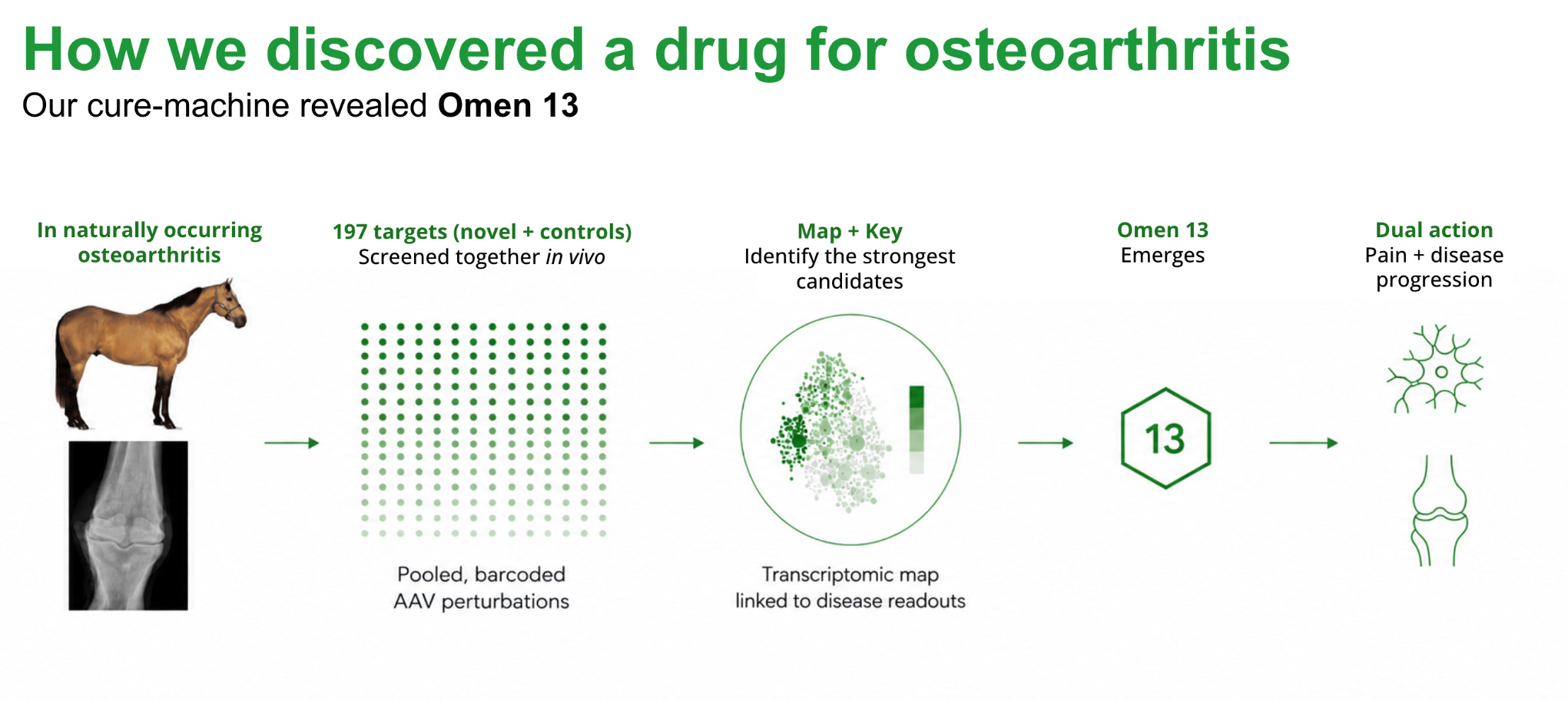
Our map and key method revealed a novel drug for osteoarthritis, and that drug is now moving toward the clinic. Omen 13 is a gene therapy candidate with dual effects on pain and disease progression. We shared the longer story of how we found it here, but long story short: it emerged from a screen of 197 independently barcoded perturbations delivered directly into diseased living tissue. Our osteoarthritis key and follow-up work across human tissue and multiple in vivo disease contexts identified it as a potent suppressor of the inflammation associated with osteoarthritis pain, while also protecting cartilage from destruction and supporting the production of cartilage matrix.
That dual action is unusual. Screening hundreds of perturbations in vivo gave us enough breadth to identify a few candidates with both effects, to pick a stronger path after seeing the broader landscape.
Our INTERACT meeting with the FDA about Omen 13 aligned us on a streamlined path to IND. Omen 13 has now advanced in IND-enabling studies to support entry into clinical trials as a gene therapy.
Powering up the machine with talent and pharma partnerships
Beneath the surface, we are continually expanding and improving our drug discovery machine.
We have programmed the machine to navigate new terrain by expanding mosaic screening to chronic kidney disease and obesity. In obesity, that expansion now includes a collaboration with Pfizer, where we are screening targets directly in visceral adipose tissue.
We’re also equipping the machine with the talent needed to keep expanding it. Over the past year, that has meant welcoming Minna Bui to medicinal chemistry, Ying Yang and Daphne Superville to single cell, and the next cohort of our Apprenticeship program: Justin Liu, Alison Arndt, Hiya Pandya, Cooper Johnson, and Anya Kuntsevich.
We’re hiring for the following roles across Gordian:
A VP of Discovery Biology to lead the discovery work that provides launches our drug programs
A Senior Computational Biologist https://ats.rippling.com/gordian-biotechnology/jobs/e41b3008-73fb-41b6-b22d-bf94e927128d
A Scientist/Senior Scientist (In Vivo Cardiac Biology) https://ats.rippling.com/gordian-biotechnology/jobs/4adf3bf8-be68-4005-9246-b3f746c2db7b
Bioinformatics apprentices to join our second cohort: https://ats.rippling.com/gordian-biotechnology/jobs/ea464752-941a-4f65-9977-31ec9cf872b5
See all open roles here.
Gordian out in the world
Gordian spent a lot of time out in the world in 2025 and 2026, including at 14 conferences and events.
Our CEO, Francisco LePort, joined panels at BIO International and the Forbes Healthcare Summit, speaking about AIxBio and scaling up causal validation. CSO Martin Borch Jensen took the stage on this topic at UNLOCK2026.
Martin organized a roundtable with ARPA-H on national longevity strategy in January, while Francisco represented Gordian at A4LI’s D.C. summits.
At the American Diabetes Association’s Scientific Sessions: Joanne Hsieh presented new work on obesity, while Gavin Pharaoh presented new work on diabetic kidney disease.
At ASGCT: Chris Towne, Linda Chio, and Kelly Fagan shared an oral presentation and three posters.
At ARDD2025, Martin Borch Jensen presented how we discovered a disease-modifying drug for osteoarthritis.
Keystone Symposia: Martin Borch Jensen, Joanne Hsieh and Naoto Muraoka gave talks on obesity and cardiometabolism, MASH, and heart failure.
Francisco and Martin also shared Gordian’s vision in interviews and podcasts. Martin spoke with BiotechTV and was featured on the Free Radicals and Biotech Nation podcasts. Francisco was interviewed by Longevity.Technology and BioXconomy and appeared with Martin on Biotech Nation.
Our collaboration with Pfizer was also discussed by Inside Precision Medicine, FirstWord Pharma and Longevity.Technology.
The Gordian machine is expanding along several dimensions.
After our osteoarthritis map revealed a rare disease modifying target, we’ve moved to producing a map of small molecule targets in cardiorenal and metabolic disease. Our keys have been getting richer, letting us interpret how those perturbations move the transcriptome along the disease <-> health continuum in these indications. We’ve already tested more targets than were published in the last 20 years.
A machine for creating time should find the most efficient ways to eliminate every disease. To that end, we are deliberately using the overlapping CRM maps to look for multimorbidity drugs with broad benefits across diseases. Like GLP1s, like SGLT2 inhibitors. Today, the industry happens upon such a drug at a rate below 1% of approvals. What will the rate be when validated effects across cells and tissues inform the search?